

By Maud Hinchee, PhD, Chief Science Officer, Agricen Sciences
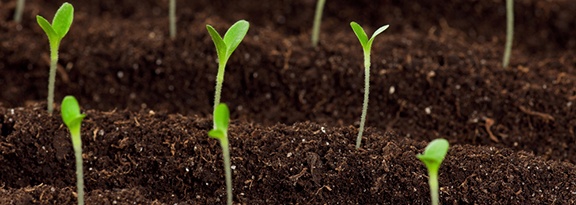
Image yourself a seed, outfitted for long-term survival in the dry and dusty seed bin. Like a bear in hibernation, you have slowed down to essentially suspended animation…waiting for the message to wake up. The first wake-up call? Water.
Once planted, only the presence of continuously available water enables your complete revitalization. Much like a bear waking up from hibernation, you are able to now use your remaining food reserves—stored in your cotyledon and endosperm “survival kits”—to generate enough energy to check out your surroundings. You can now sense moisture, light, and temperature, and determine the safety of emerging from your seed coat “cave”.
It is now the seed versus the world. For the seedling, survival requires “selfish” decisions to win the campaign for water, nutrients, light and space. The growth and development decisions made now and in the future will make or break a seedling’s success, and will be the key to ensuring that it—and not its competitors—gains the prize of plentiful progeny for generations to come.
The spearhead of the seedling’s first sortie into the world is its emerging root. Root growth rate and direction is not random—it is directed by signals from the environment. But what is the root sensing? What decisions is it making? Can we say that the root is demonstrating “intelligence”?
The “Root Brain”
Paco Calvo Garzón of the University of Murcia inSpain and Fred Keijzer of the University of Groningen in Netherlands propose in the journal Adaptive Behavior that one could potentially consider the portion of the root that controls its growth as acting like a “root-brain”, with decision-making capacity.
Scientists are now discovering that the transition zone, found between the region of cell division and cell elongation in the root tip, receives and integrates multiple sensory signals in response to environmental cues. The root responds to these cues by adjusting its growth rate, direction and control of lateral branch root position to achieve additional footholds that ensure maximal access to water and nutrients. A good look at this control point in the root can be seen in this microscopic time-lapse view of a growing root generated by Giovanni Sena (New York University) and Zak Frentz (Rockefeller University) and described in their 2011 publication in PLoS One.
The initial root emerging from the seed needs to move quickly into soil and establish branch roots. Root architecture is the result of the transition zone’s decision as to which cells divide or elongate. Cell division and elongation are the means by which a root can change how fast and where it moves through the soil. The elongating cells behind the actively growing cells of the root apex essentially push the growing point forward. Where the cells elongate affects root direction. A root changes its path much like a military procession that makes a corner – those marchers on the outside need to increase the length of their stride while the inside marchers just march in place. A similar thing happens in the transition zone, where cells on the outside elongate more than the ones on the inside to make a bend. Time-lapse photography by Matthew Thompson and Michele Holbrook of Harvard University shows how a root redirects its growth when it comes in contact with a high friction gel surface (think experimental version of a “rock”), also described in their 2004 Plant Physiology publication.
Plant Hormones: The “Neurobiology” Behind Root Response
Researchers have shown that the hormone auxin—in partnership with the other plant hormones cytokinin, ethylene and gibberellin—is crucial in the root’s perception and response to environmental signals. It is the balance of transported auxin (produced in the growing shoot moving towards the root tip) with transition zone-produced auxin that controls the timing and rate of cell elongation and dictates the future potential sites for the production of lateral roots. In 2010, the laboratory of Jiří Frimlat Ghent University, Belgium, showed that auxin interacts with plant cell membranes in a manner similar to processes found in the synapses of animal nervous systems, indicating a commonality in signal transduction that is a highly evolutionary conserved process. This finding basically means that signal transduction in plants has similarity to the neurobiology of animals.
Bolstering Root Growth Potential
The internal complement of phytohormones can be off balance, and not sufficient to promote the necessary root growth and territorial gain needed for survival. However, the plant can call in allies to bolster its root growth potential. In a microscopic barter, roots exude carbohydrates that act as food offerings to soil microbes who in turn accommodatingly produce auxins that are then consumed by the plant as a supplement. In this way, these microbes are essentially providing support to the plant in its goal to produce larger, more branched root systems.
The root systems of young seedlings of agricultural plants also have another strong ally – the farmer. Besides the addition of fertilizer, farmers can help by applying growth stimulators. For example, auxins are found in many of the biostimulant products used to ensure good seedling establishment. One example would be Radiate®, which contains auxin and cytokinin and promotes increased root mass in seedlings.
Some farmers use humic acids and/or seaweed extracts to stimulate root development. Humic acids have recently been shown to stimulate the auxin signaling pathway in plants roots, and although the plant auxin IAA has been found in humic acids, researcher Sara Trevisan and her colleagues at the University of Padua, Italy, reported in 2010 that the auxin-like effect from humic acid treatments is not explained by the very small amount of IAA present. Seaweed extracts, especially those produced by marine brown algae, contain auxin and other plant growth regulators, but also contain carbohydrate polymers that could be acting as signaling molecules to promote growth. Another type of biostimulant product, Accomplish® LM, which is a natural soil additive produced through microbial fermentation, has very well documented effects on encouraging the development of root systems in young seedlings.
The signaling molecules generated from all of these agricultural products are providing messages that assist the transition zone of the root in making those critical decisions that affect when, where and how a root system develops.
So, is a germinating seedling a sentient being capable of assessing the environment and taking actions to benefit its survival? And is it actively interacting with its environment to better its circumstances? It appears so, based on the research summarized here. Stayed tuned as we follow the seedling on its sensory exploration the world in future posts.
 Have you ever marveled at a dandelion that forced its way through an asphalt road to sunshine? Or have you wondered how a Venus fly trap knows when to snap its jaws shut to capture its prey? Or how that pesky sedgegrass in your lawn seems to come back in greater numbers in the face of herbicides and hand pulling? Plants, including crop plants, are constantly responding to their senses. They can see, touch, smell, taste and sense water, food and predators—and they can remember. Of course, they don’t do all of this exactly the way a human does, but they do respond to messages they receive from the world around them to survive, thrive and extend their family through reproduction—much the way we humans do.
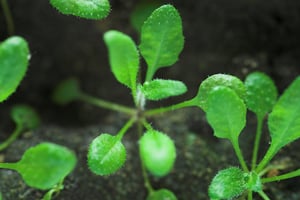 A study published in BMC Plant Biology demonstrated that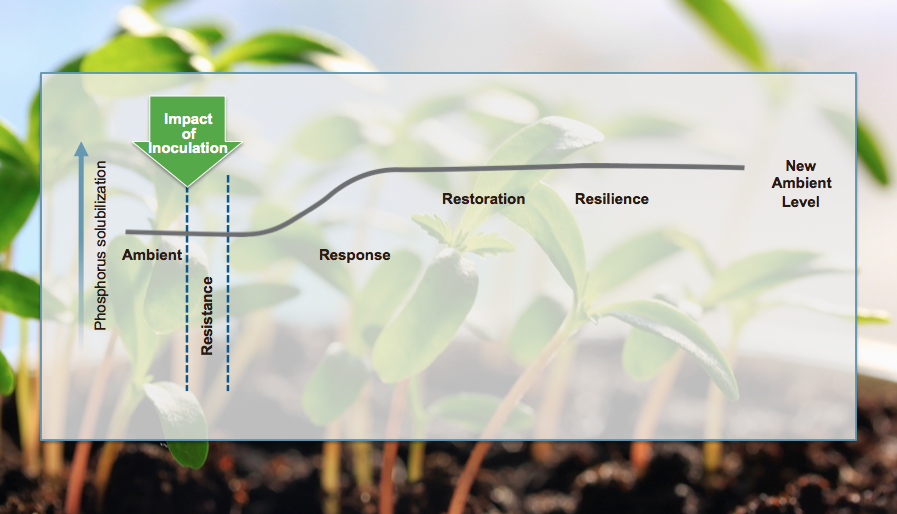
 In agricultural soils, the impact of farming on various species within microbial communities and their functioning may be beneficial or harmful. Many published studies have addressed this subject, comparing conventional, sustainable, organic, or a mixture of practices characteristic of these systems. The results clearly indicate that the different farming practices result in changes in microbial community composition; however, there are no clear correlations between these microbial changes and agricultural productivity.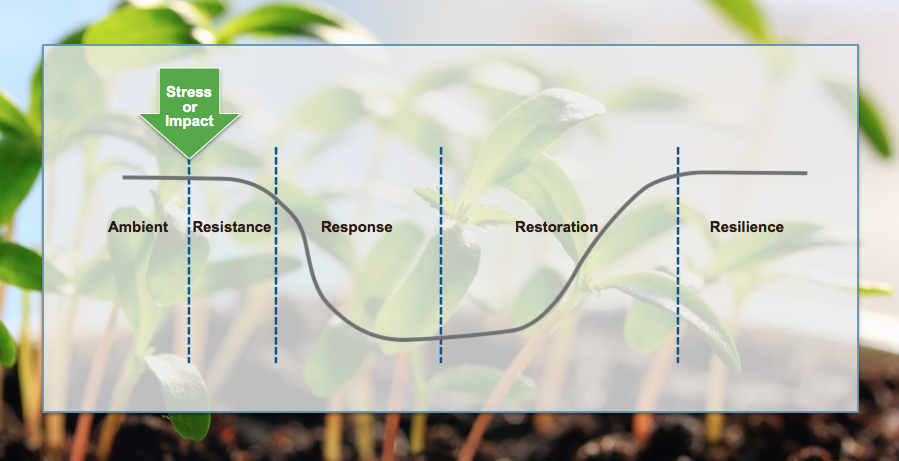
 As previously mentioned, we can recognize stress on agricultural crops fairly easily based on poor growth, wilting or disease symptoms. However, we rarely consider stresses on the functioning of microorganisms in the soil – mostly because they can’t be easily seen, and we don’t really understand how most of these organisms function. We do know that the life cycle of individual soil microorganisms is short and may be only a few hours or days for many of them. So any disturbance of the soil will have an impact on the microbes present and their functioning within the microbial community.
 Most who are involved in the agricultural industry understand that agricultural productivity is dependent on a variety of crop inputs, management practices and environmental factors that ultimately influence the quantity and quality of the crops harvested, as well as profits for the grower. In recent years, we’ve become very aware of the impact of environmental stresses due to drought, and even excessive rain, on crop yield. It has also been stressed that agricultural productivity must be considerably increased if we’re to meet the demands of an increasing population. Thus, the burden on the agricultural community is to produce more in a sustainable manner that minimizes adverse environmental affects and is minimally impacted by stress conditions. All of these present major challenges, with the ability to minimize environmental stress being the most difficult.